We hold the design responsibility and we own every shop that touches your vessel: engineering, cutting, forming, machining, welding, code stamp. One supplier, one schedule, one party accountable.
Most pressure equipment projects lose time in the gap between the concept and the shop floor. An engineer sizes the vessel, a fabricator quotes it, and somewhere between those two the questions start. Can this head be formed at this thickness? Is the nozzle projection reachable? Why is the material three weeks out? Each one becomes an RFI, and each RFI is a schedule item that nobody priced.
Arrow Engineered Products closes that gap by holding both ends. We are the engineers on the project. Design and ASME Section VIII code calculations are done in-house, and the same organization that produces the calculations also cuts, forms, machines, welds, tests, and stamps the equipment. When the design and the fabrication share an employer, a forming limitation is a design decision made in an afternoon rather than a change order raised six weeks into the job.
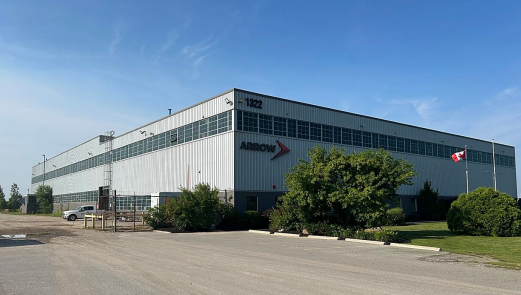
Three facilities carry that work. Stratford is our ASME Section VIII pressure vessel shop, with pressure vessel fabrication coming online at Woodstock. Woodstock provides plasma cutting, precision forming, and fabrication. Cambridge North provides precision cutting and machining. One company, three plants, and a single chain of responsibility that runs from the first concept sketch to the finished, stamped vessel.
We Hold the Design Responsibility
Arrow Engineered Products can take full design responsibility for a project, or fabricate to a design you already own. Both routes are available, and the distinction matters at the quoting stage.
When we hold design responsibility, the engineer specifying the shell thickness works in the same organization as the people rolling it. That has practical consequences:
- The design is written to be built. Thicknesses, radii, and nozzle layouts are checked against the forming and machining capability that will actually produce them, not against a generic assumption.
- Constructability questions are resolved internally. They do not become RFIs that sit in your inbox waiting on a third party.
- Revisions propagate once. A design change reaches the cutting table, the machine shop, and the welders the same day it is issued.
- One party is accountable for the result. If the finished vessel does not meet the specification, there is no interface between designer and fabricator to argue about.
For a project engineer, this is the difference between managing a design package and managing a vessel.
The Three Facilities
Each plant does one thing well, and the three of them line up in the order the work flows:
- Stratford – ASME Section VIII pressure vessel fabrication. The code shop, where pressure equipment is welded, inspected, tested, and stamped.
- Woodstock – Plasma cutting, precision forming, and fabrication. Prepares and forms the material that feeds the pressure work, with pressure vessel fabrication capability coming online.
- Cambridge North – Precision cutting and machining. Produces the machined components and close-tolerance detail that finished pressure equipment depends on.
Cutting, forming, rolling, and machining are not adjacent businesses that happen to sit near a pressure shop. They are the front end of it, and they answer to the same project manager and the same delivery date.
Read More: About Arrow EP
What We Build
Arrow Engineered Products engineers and manufactures a broad range of pressure equipment and related systems for industrial applications, including:
- Pressure vessels
- Power boilers
- Heating boilers
- Heat exchangers
- Reactors
- Tanks
- Power piping (ASME B31.1)
- Process piping (ASME B31.3)
- Nuclear fabrication
- Shop assembly
- Repair and modification
New equipment, specialized fabrication, or repair and modification work: the engineering is ours, the code work runs through the code shop, and the supporting scope runs through the plants built for it.
Read More: Our Capabilities
What This Removes From Your Project
The value of this structure is measured in work you no longer have to do. You are not qualifying a design house, a pressure fabricator, a forming shop, and a machine shop separately, then coordinating the four of them and owning the gaps between them.
Fewer suppliers to approve. Fewer handoffs where scope and documentation get lost. No interface risk between the party that designed the vessel and the party that built it. And schedule flexibility, because upstream capacity can be prioritized for pressure work when a project needs it. It is our capacity to prioritize.
Start the Conversation
If you are planning a pressure equipment project, start with the scope: the service conditions, the applicable code, the materials, and the schedule you are working to. Bring us a specification or bring us a problem. Either is a starting point.
Tell us what you need built, and we will show you exactly how it moves from concept through to a finished, stamped vessel, and who is accountable at every step.