Industrial processing equipment and nuclear components are designed for very different applications, but they answer to the same physical realities: pressure, temperature, corrosion, fatigue, and stress. The drawings might look different and the end customers definitely are, but the quality discipline behind a well-built chemical processing vessel and a well-built CANDU pressure-retaining component is, in practice, the same discipline.
That’s the lived reality across our shops at Arrow Engineered Products. We fabricate for both industries, and we run our quality programs to satisfy the demands of each on any given job. Step-by-step process control isn’t something we add on for nuclear work and dial back for industrial, it’s in the DNA of the shop, on every job, every traveler, every part.
This post walks through four places where the two industries share the same technical ground, and what we do day-to-day to make sure the parts we ship meet the standard.
1. Materials and Welding: The Failure Modes Don’t Care Which Industry You’re In
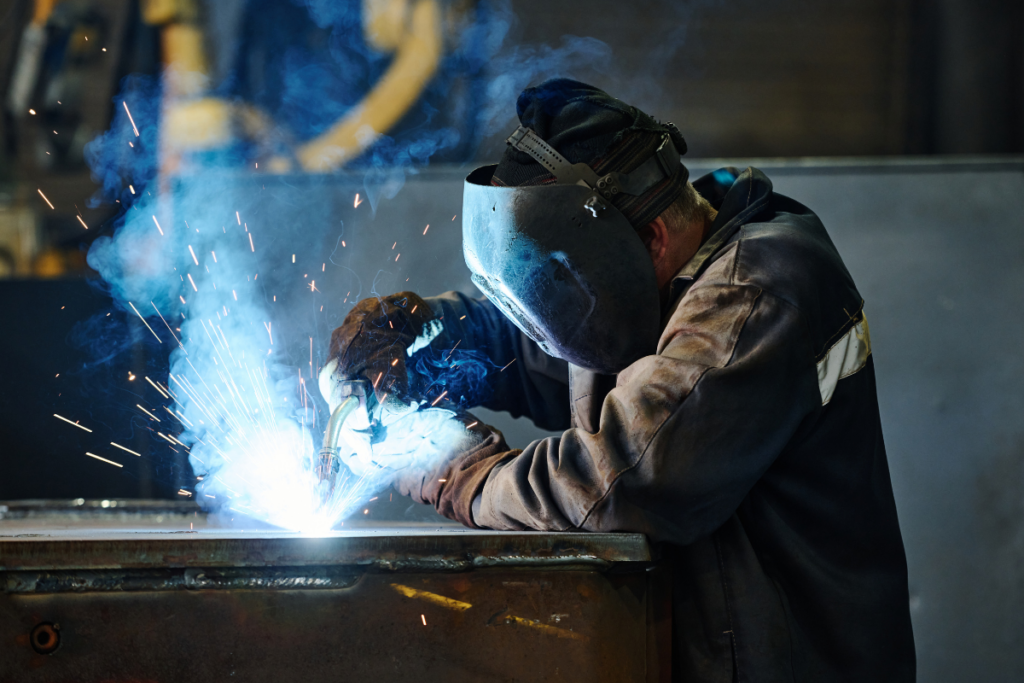
Stainless steel can crack under the wrong conditions whether it’s heading to a CANDU station or a chemical plant. A weld that hasn’t been done properly will fail in service the same way regardless of which building it ends up in. The metallurgy and the welding don’t care about the application.
That means the controls have to be the same in both cases: the right grade of material chosen for the service, qualified welders following qualified procedures, controlled heat input during welding, and inspection at the points where it matters. Whether the next stop is a reactor building or a high-pressure chemical manifold, the finished part has to be free of the problems that lead to premature failure in service. That discipline has to be there from the first cut, on every job.
2. Tolerances and Surface Finish: Built To The Codes That Govern The Service
Both industries produce drawings with complex, intricate geometry that has to be held repeatedly across a production run. What matters is the right tolerance in the right place, held consistently across every part in the batch — and, just as importantly, held to the code that governs the part.
Heat exchangers are a good example. Tube sheet tolerances, tube spacing, and assembly standards are governed by TEMA (the Tubular Exchanger Manufacturers Association), which sets the baseline that both industrial and nuclear heat exchanger work is built against. Sealing surfaces on flanges have their own finish requirements depending on the service and the type of gasket used. The drawing and the code book together tell us what the part has to be, our job is to hit it, every time.
Material and consumables traceability is a crucial part of that discipline in both sectors. Base material is traced by heat number from the mill certification through to the finished part, and the same standard applies to welding consumables: filler metal, shielding gas, and flux are all tracked on the traveler. A weld is only as traceable as the wire that made it, and on high-integrity service in either industry, that level of record-keeping is the expectation, not the exception.
3. Process Control: What “Step-by-Step Quality” Actually Looks Like
“Tight process control” is one of those phrases that means everything and nothing. On our floor, it means a specific set of practices that run on every job, regardless of industry:
First-article inspection before a production run is released, with results documented against the drawing. Material verification on incoming bar, plate, and forgings, not just trust in the paperwork. Qualified welders following qualified procedures that match the joint and the material. In-process measurement on critical dimensions for repeat parts, so drift is caught at the machine, not at final inspection. Calibrated measuring equipment with certificates available to the customer on request.
When variability is engineered out of the process up front, batch-to-batch consistency stops being a hope and becomes an outcome. That’s what lets a chemical processing customer or a nuclear customer plan commissioning around a delivery date and trust that the parts will behave the same way the qualified first article did.
Read More: Why Quality Documentation Is Critical For Nuclear And Industrial Processing Fabrication
4. Documentation: Knowing Exactly What You Shipped
Nuclear fabrication has always been documented to a high standard. Industrial processing has its own well-established documentation expectations, and on high-integrity service the requirements look very similar.
The reasoning is the same in both cases: when something fails in service, the questions that get asked are the same. Which material? Which welder? Which procedure? Which inspector? Which date? If the answer to any of those questions is “we’re not sure,” the investigation stops and the corrective action can’t happen. Documentation isn’t paperwork for its own sake — it’s the mechanism that turns a failure into a fix, and prevents the same failure from happening twice.
Every part we ship carries the records it needs for its service: material traceability, signed-off operations through every step, and inspection records attached. The level of detail scales with the application, but the discipline behind it doesn’t change.
Shared Discipline
Arrow operates multiple quality programs across the group, different shops, different scopes, and different certifications matched to the work each one does. What’s consistent across all of them is how parts are treated and how the work moves through the floor. The material controls, the inspection routines, the welder qualifications, and the documentation expectations are built around the same disciplined approach, whether the part is heading to an industrial processing plant or a nuclear facility.
That’s the practical implication for anyone sourcing this kind of work. Step-by-step quality is the default across our operations, not a setting we switch on for one industry and off for another. The same approach, the same people, and the same standards of accountability serve both industries every day.
Read More: How AEP Is Prepared To Support Ontario’s Growing Nuclear Industry
The Programs Behind The Claim
Arrow’s certifications and compliance programs span quality management, nuclear, pressure equipment, and welding — the full set of standards both industries draw on. They’re grouped here by what they actually govern:
Quality Management System
- ISO 9001:2015 — held at each of our shops; the foundation our quality programs are built on
Nuclear
- CSA N299.2 and N299.3 — quality assurance program requirements for the supply of items and services to nuclear power plants, covered across our shops
- CSA N285.0 — general requirements for pressure-retaining systems and components in CANDU nuclear power plants; our scope covers Class 1 through 4 vessels, storage tanks, H-type fittings, parts, piping subassemblies, tubular products welded with filler metal, and repair or modification of nuclear items
Pressure Equipment Design, Fabrication, And Registration
- ASME Section VIII — design and fabrication of pressure vessels (“U” Stamp)
- ASME Section I — power boilers (“S” Stamp)
- ASME Section IV — heating boilers (“H” Stamp)
- ASME B31.1 — power piping
- ASME B31.3 — process piping
- CSA B51 — Canadian boiler, pressure vessel, and pressure piping code
- TSSA — Ontario authority recognition for pressure equipment, including repair and alteration scope
- National Board “NB” Mark — authorized to register pressure-retaining items with the National Board
- National Board “R” Stamp (NB-415) — accredited for metallic repairs and alterations at shop and field locations
- PED 2014/68/EU — European Pressure Equipment Directive compliance, Annex III Modules H and H1, for export work
Welding
- CWB CSA W47.1 — certification for fusion welding of steel
- CWB CSA W47.2 — certification for fusion welding of aluminum
Taken together, this stack of programs is the reason our operations can serve both a CANDU refurbishment and a chemical processing build with the same disciplined approach to fabrication, inspection, and documentation.
Talk To Arrow About Your Next Build
Arrow is actively expanding the scope of work we take on, including commercial nuclear projects in the US market and ASME Section III certification, which we are currently pursuing for nuclear construction code work. If you’re sourcing pressure-retaining, heat transfer, or high-integrity processing equipment, in either industry we’d welcome a conversation. Visit www.arrowmfgep.com/contact to get a quote or talk through the requirements on your next project.